
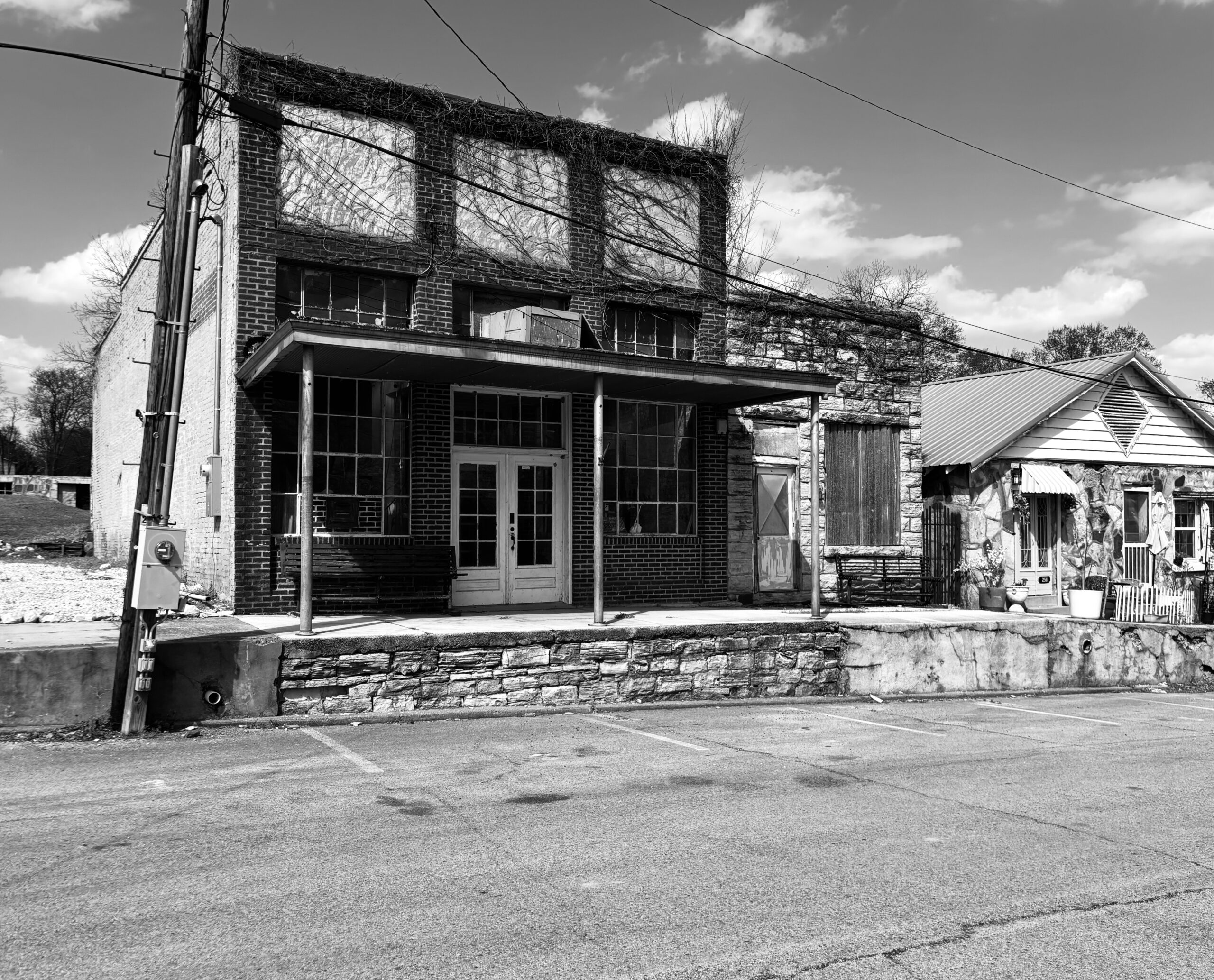
On the morning of June 16th, 1933, three armed men entered the First National Bank building at Black Rock and robbed the bank taking a cashier named L.B. Sharp hostage. Witnesses stated the men marched Sharp right past Williams Drug Store and into a Plymouth car with Missouri license plates. The Plymouth was stolen from a traveler in Newport along with $15 dollars in cash; $5 of which they gave back before leaving with his car.
The kidnappers were members of the Bailey-Underhill Gang, a notorious group of robbers that operated primarily in Oklahoma, Kansas and Missouri. Wilbur Underhill had recently escaped along with 10 others from a Kansas prison with assistance from Frank “Jelly” Nash, considered the most successful bank robber in US history.
The three kidnappers reportedly left Black Rock and traveled to Powhatan where they were said to have paid the toll and crossed the Black River entering the east side of Lawrence County. A few miles down the road, the kidnappers released Mr. Sharp at Lauratown, wishing him luck as they left him on the side of the road. Sharp was eventually picked up by County Clerk Everett Steele who enroute to Powhatan.
Shortly after releasing Mr. Sharp, pursuit began between the kidnappers and law enforcement out of the Lauratown area according to eye witness accounts. The Plymouth was last seen by pursuing officers turning right and heading toward the river. It was later found abandoned about 1/4 mile from a local ferry.
Investigators learned two other members of the Bailey-Underhill Gang had been posing as fishermen and were camped near where the Strawberry River emptied into the Black River, three men dressed in suits had been seen by locals visiting the two fisherman in the days leading up to the robbery and kidnapping. These men were never seen again after the day of the robbery in Black Rock.
The criminals continued to zigzag through northeast Arkansas as posses from Lawrence County, Jackson County and Independence County were formed. Officers from as far away as Jonesboro joined the efforts.
The second kidnapping associated with the Black Rock First National Bank Robbery occurred later that same day when the gang stopped Bob Coleman of Cord and he was kidnapped and forced to drive the kidnappers toward Batesville, but not before tipping off a filling station attendant who contacted Batesville Police. BPD attempted to set up roadblocks but the kidnappers slipped through.
The 3rd kidnapping occurred the next morning in Batesville. John Holmsley was approached in a garage and ordered to drive them to Walnut Grove where they gave Holmsley $15 and left him unharmed.
Police were discovering several clues indicating this was a well planned robbery including two vehicles discovered in the Cord area. The two vehicles were full of fuel, weapons and ammunition. One vehicle had Oklahoma license plates the other had Texas license plates.
At this point investigators developed several suspects. Two of the suspects were arrested in a raid of a house believed to be a hideout of the Bailey-Underhill Gang. The two were apprehended in the house along with a stash of weapons. They were identified as Dewey Shipley and Morris Hersh but no sign of any known Bailey-Underhill gang members.
After the arrest of Shipley and Hersh, a publishing company in Oklahoma received written correspondence from the Bailey-Underhill Gang signed by all 5 men claiming the authorities had the wrong suspects and taking responsibility for the kidnappings and robbery, even going as far as identifying each member involved and fingerprints to prove they were indeed responsible.
Authorities then charged Thelbert Brady, age 23 and Jack Wyatt, age 38 in Oklahoma after authorities caught them with checks taken from the robbery. After 25 witnesses came forward saying Thelbert Brady had been in Reno Oklahoma on the day of the robbery, an Oklahoma judge released Brady. Wyatt was extradited back to Lawrence County where he was tried in Powhatan and acquitted by a judge after he reportedly deliberately for only 4 minutes.
After Wyatt’s acquittal, Shipley’s trial was postponed to the next session and he returned to Oklahoma where he once again went on the run.
With no explanation, on December 31st 1935 the Oklahoma Governor granted Shipley a full pardon and restored all rights after Shipley had been evading authorities for over a year. Shipley was wanted for an earlier prison escape and for questioning in several bank robberies. Shipley returned to Texas where in March 1937 he was arrested and convicted for a bank robbery in Dallas.
As for the known members of the Bailey-Underhill Gang who admitted to the Black Rock robbery and kidnappings, the letter stated “we sympathize with the accused who are innocent and want no man to suffer for our acts”.
The Black Rock Bank Robbery was big news and was printed nationwide in newspapers, accounts of how much money was stolen varied. Reports as high as $29,000 in cash, coins and money orders and as low as $4700. Even the alleged robbers disputed some reports. In their letter to the Oklahoma Publishing Company, the writers gave the amount of $4700.
The members:
Wilbur Underhill died after a shootout with authorities in Oklahoma where he was shot 5 times and died in an Oklahoma prison hospital handcuffed to a bed.
His last words, “tell the boys, I’m coming home”
Bob Brady, a habitual offender continued his crime spree. He was sent back to prison where he escaped again continuing his crime spree and was eventually shot and killed by an undersheriff after his gun misfired in Kansas on Jan 22,1934.
Jim Clark who was an escapee previously convicted and sentenced 20-100 years for robbery, was captured in 1934 and sent to prison until his 1964 release. After his release he worked as a parking lot manager at an Oklahoma bank until he died in 1974
Harvey Bailey continued his crime spree until being convicted of kidnapping in October 1933 and serving time in both Alcatraz and Leavenworth until pardoned in 1964. Bailey lived to the age of 91 and died in 1979 in Joplin Missouri where he had married and worked in a furniture factory as a woodworker.
Ed Davis retired from crime believing he’d amassed enough money and moved to California where after running out of money he attempted to rob a local store where he was captured and linked to several other crimes. Davis was sentenced to Folsom Prison where he attempted escape by kidnapping the warden and two guards. The warden and guards were killed when gunfire erupted during escape. He was sentence to death for his role in the death of the guards and warden.
He was transferred to San Quentin Death Row just one week before being executed on Dec 16th 1938.
No convictions were ever secured for the Black Rock First National Bank robbery and the three kidnappings that followed, none of the five known members of the Bailey-Underhill who admitted to their involvement were ever charged.
Of the four men that were questioned and charged, they were either not tried, acquitted or had charges dismissed by a judge.
Federal Investigators have long believed that Frank “Jelly” Nash was the mastermind behind the planning of the robbery. Nash was believed to run several gangs and was involved in an estimated 200 robberies. Nash was killed in the Kansas City Massacre on the morning of June 17th, the day after the bank robbery.
Note: Special “Thank You” to Mr. Pat Roby Sr. for the information and inspiration to tackle this story.
