
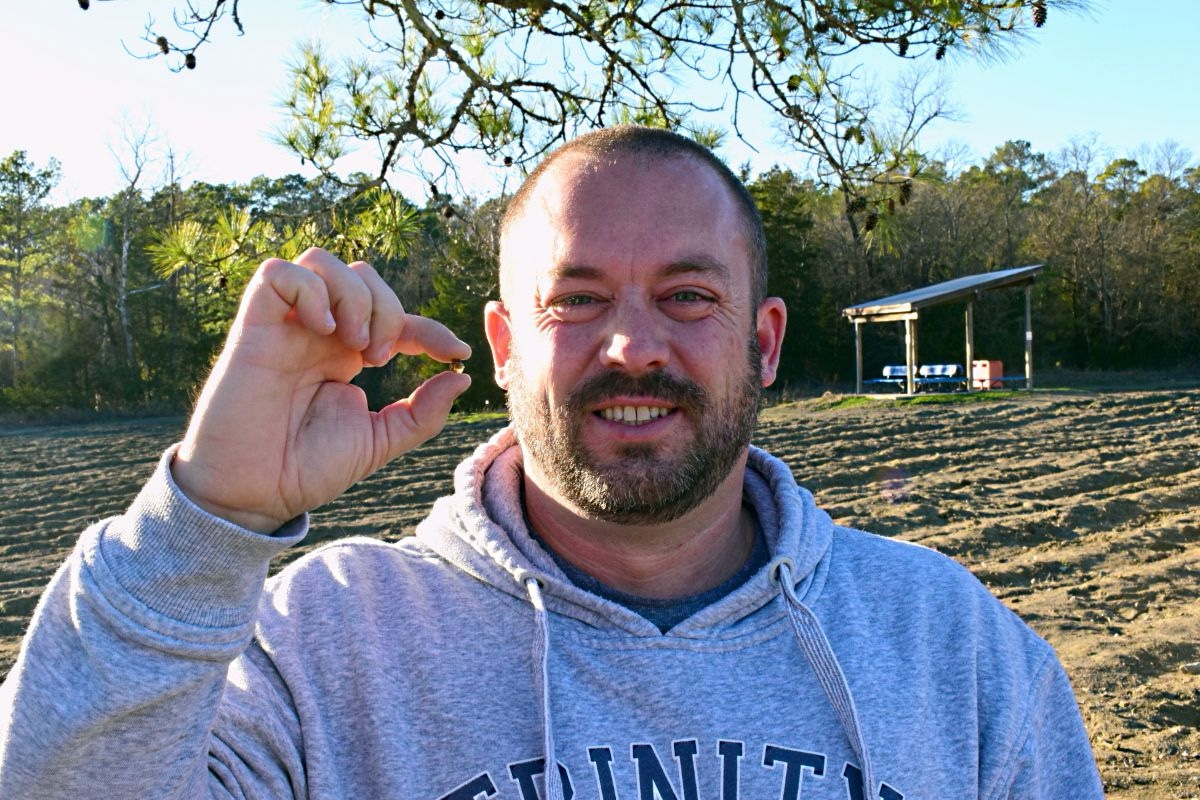
MURFREESBORO, Ark. – A casual question to a virtual assistant led to an exciting discovery for a Texas family at Crater of Diamonds State Park. James Ward, a 41-year-old high school teacher from Cypress, found a 2.09-carat brown diamond on Tuesday, December 30, while visiting the park with his wife, Elizabeth, and their two sons, Adrian (9) and Austin (7).
Their journey began in mid-December at the family’s home. “One day we were watching TV, and Austin came and said, ‘Mommy, Mommy, is there any place in Texas or nearby that we can mine for crystals?’” Elizabeth Ward recounted. After asking Siri for nearby mining locations, the family was directed to Arkansas’ diamond site. “I sent the link to James, and he’s like, ‘Oh wait, that’s only like six hours away. We can go!’”
With no set plans for the holidays, the family quickly organized their trip and arrived at the Crater of Diamonds State Park on Monday, December 29. Though they spent four hours searching the first day, the winter weather nearly cut their trip short. Elizabeth Ward noted that they originally considered heading home early. “We were so cold! We were here for, like, four hours. It was freezing, but Adrian was the one who wanted to come back,” she said.
The family’s decision to return for a second day proved fruitful. After just two more hours of searching, James Ward was raking through dirt with his fingers near the West Drain section of the park’s 37.5-acre diamond search area when he spotted a metallic-looking crystal in the soil. “I didn’t know what it was, but I knew it was different than everything else I had found,” said Ward.
James Ward picked up the shiny stone and put it in a paper sack with the rest of the family’s finds. Before leaving, they stopped by the park’s Diamond Discovery Center, where staff confirmed that Ward had found a 2.09-carat diamond.
According to Assistant Park Superintendent Waymon Cox, “Mr. Ward’s diamond is about the size of a corn kernel, with a dark yellowish-brown hue and a beautiful, metallic luster characteristic of all Crater diamonds.”
Cox also notes that the shield-shaped gem is a broken crystal. “Crater diamonds formed in the upper mantle and were carried to the surface by an ancient volcanic pipe,” Cox explains. “Most are chipped, broken, or include flaws from the immense geological forces they endured. Given its current size, you can imagine how much bigger Mr. Ward’s diamond might have been as a complete crystal!”
Many visitors choose to name the diamonds they find at the Crater of Diamonds State Park. James Ward called his gem the Ward Diamond to commemorate the special experience with his family.
As for the future of the diamond, James Ward is keeping his options open. “No idea,” he said when asked if he plans to sell or keep it. “I’ll have to see how much it’s worth first.”
The Wards left the park with more than just a gemstone; they left with a story of persistence. “You can stumble upon a diamond in any place or time,” Ward noted. “Don’t give up on the first day!”
Elizabeth Ward added, “Listen to your kids about their dreams and what they want to do!”
The Ward Diamond was one of five diamonds found on the surface of the search area in December. At the close of the year, park staff had registered 540 diamonds.


Quick Facts about Crater of Diamonds State Park
Diamonds come in all colors of the rainbow. The three most common colors found at Crater of Diamonds State Park are white, brown and yellow, in that order.
In total, over 75,000 diamonds have been unearthed at the Crater of Diamonds State Park since the first diamonds were discovered in 1906 by John Huddleston, a farmer who owned the land long before it became an Arkansas State Park in 1972.
The largest diamond ever discovered in the United States was unearthed in 1924 during an early mining operation on land that later became part of Crater of Diamonds State Park. Named the Uncle Sam, this white diamond with a pink cast weighed 40.23 carats. It was later cut into a 12.42-carat emerald shape. The Uncle Sam is now part of the Smithsonian’s mineral and gem collection and can be seen at the National Museum of Natural History.
Another well-known diamond from the park is the Strawn-Wagner. Found in 1990 by Murfreesboro resident Shirley Strawn, this 3.03-carat white gem was cut into a round brilliant shape weighing 1.09 carats. It graded as ideal cut, D-colorless and flawless and was set in a platinum and 24-carat gold ring. In 1998, the state of Arkansas purchased this diamond for $34,700 in donations and placed it on permanent display at the park visitor center.
Crater of Diamonds State Park is located on Arkansas Highway 301 in Murfreesboro. It is one of 52 state parks administered by Arkansas State Parks, a division of the Arkansas Department of Parks, Heritage, and Tourism.